SolutionsAI / Headless

AI

Your research data, working for you.

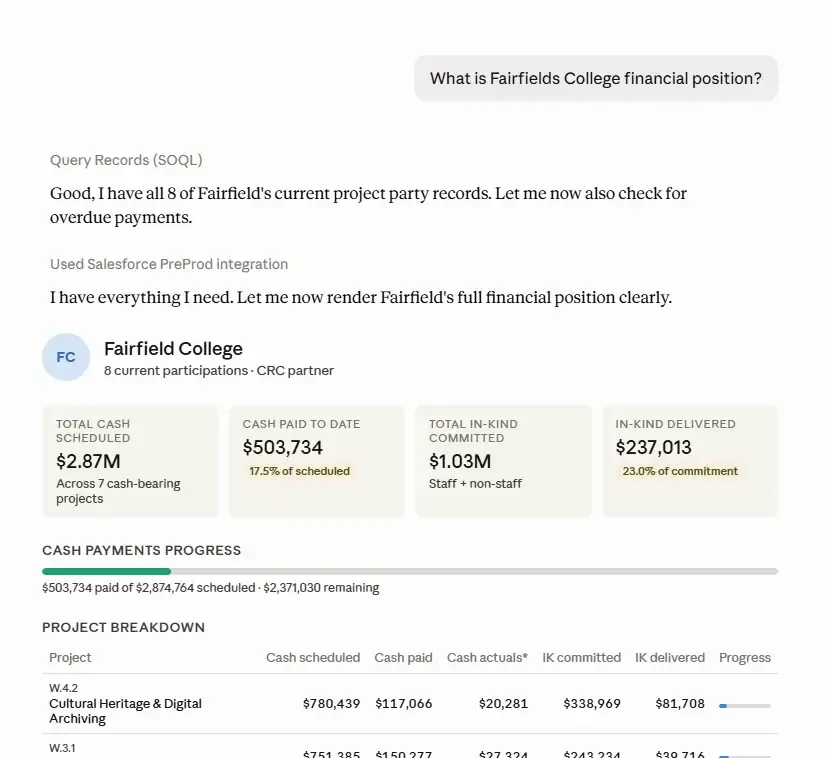
Salesforce Headless 360 makes every part of turnKeyRM, its data, workflows and business logic, available as an API or MCP tool. That means your AI app can read your research records and, where you allow it, act on them, under the same security and permissions as the people who use the system. No separate AI platform, no copy of your data somewhere else, and no development project to get started.

How it works

How it works

Headless separates the platform from the interface. turnKeyRM holds the projects, people, money, obligations and outputs; the AI layer sits on top of that record and can be used from wherever your team already works, whether that is Claude, Slack, MS Copilot or ChatGPT. Your AI app sees exactly what the signed-in user is allowed to see, every answer traces back to the records it came from, and nothing is written back without a person confirming it.

That is the point of building on a system of record first. The AI is only as useful as the data underneath it, and in turnKeyRM the data is structured, governed and already there.


What you can do

What you can do

Six areas cover what an AI layer on a system of record is good for, from answering a question to building the screen that asks it. Each one works on live turnKeyRM data with its permissions intact, and each is available on day one without a development project.

1. Ask questions, get governed answers

Ask in plain language, in Claude or Slack, and get an answer drawn from live turnKeyRM data with the source records attached. “Which projects have a milestone due this quarter with no deliverable logged?” is a question, not a report request.

  • Portfolio and project questions answered from the live record
  • Answers that cite the records they came from
  • Act on the answer in the same place: trigger a workflow or an approval without opening Salesforce

2. Exception reporting and ad hoc reports

Standard reports tell you what is normal. The useful question is usually what isn’t. Describe the exception and the AI finds it: the unusual, the overdue, the one-off report a funder asked for on Friday afternoon.

  • Exceptions surfaced on request or on a schedule: overdue obligations, budgets drifting from plan, partners with no engagement in six months
  • One-off reports built from a description rather than a reporting ticket
  • Results you can send back as a turnKeyRM report once you want them to recur

3. Analytics beyond standard reporting

Salesforce reports and dashboards are good at counts, sums and filters. Research questions are often harder than that: trends across years, comparisons between cohorts, anomalies, forecasts.

  • Trend and cohort analysis across the portfolio and across time
  • Forecasting of spend, milestone delivery and partner contributions from the project record
  • Charts and written analysis produced from the data, with the working shown

4. Data hygiene and governance

A system of record is only as good as its records. The AI checks them continuously against your rules and tells people what needs fixing, rather than waiting for an audit to find it.

  • Gaps, duplicates and inconsistencies flagged to the person who owns the record
  • Data entry and maintenance rules applied as records change
  • Identifier checks, so people, organisations, projects and outputs resolve to their ORCID, ROR, RAiD and DOI
  • Reconciliation against external sources, such as matching Xero invoices and payments to partner funds in turnKeyRM

5. Automated logging and next steps

Most CRM data is never entered because entering it is the last thing anyone wants to do after a meeting. The AI does it from the notes, the email or the transcript, and proposes what should happen next.

  • Meeting notes and emails turned into engagement records against the right contact, organisation and project
  • Follow-up tasks and next steps drafted for the person to confirm
  • Nothing written to the record without a person approving it

6. Bespoke interfaces without the development bill

Some teams need a screen that doesn’t exist: a partner-facing portal, a milestone board for one centre, a reconciliation workbench for finance. These used to mean a quote, a backlog and a wait. Now they are built against turnKeyRM data in days, described in words and iterated with the people who will use them.

  • Purpose-built views and tools for a team, a role or a single process
  • Built on live turnKeyRM data with its permissions intact
  • Changed as the process changes, not re-scoped as a new project

Our Solutions

turnKeyRM

The system of record. A Salesforce-native research information management system that holds projects, stakeholders, finances, governance and outputs in one place, from Pre-Award through to Post-Award. In use across 26 research centres in Australia.

Persistent Identifiers

Sharper records. turnKeyRM carries the five national priority PIDs, ORCID, ROR, RAiD, DOI and IGSN, so people, organisations, projects and outputs resolve to something you can check.

AXIS lifecycle maps

A practical mapping workshop that turns complex operations into a clear, shared lifecycle view, surfacing handoffs, bottlenecks and system requirements.

News

Insights that match our
knowledge.

Why Persistent Identifiers Are the Next Layer on Top of Clean Research Data

Getting your own house in order with a single source of truth for projects, researchers, and outputs is the dream for many research centres.

August 2026

Headless: No Head, All Brain

If you manage research projects, you don't just live in a research management system like turnKeyRM.

Headless is the name for closing that gap.

August 2026

turnKeyRM named an iAwards finalist

A milestone for a platform that has supported Australia’s research sector for a decade, now adopted by 23 CRCs and recognised in the Not-for-Profit & Community category at the iAwards Queensland.

June 2026

Let's bring
things into focus.

See what your own data can tell you

Book a Demo